
Alex Cerqueira de Araujo
Senior Bioinformatician
Position: Senior bioinformatician
Project: Comparative genomics and evolution of hymenopterans
Research Interests
My work focuses on the evolution of organisms, especially the evolution of arthropod genomes.
I use genomic, transcriptomic and proteomic data to find evolutionary patterns among species. These patterns can take several forms, from single nucleotide polymorphisms to chromosome structural changes — they help me better understand the link between genome and phenotype, and to draw evolutionary relationships between organisms. In combination with phenotypic features, genomic features can also be used to predict species life-history traits and evaluate species susceptibility to, for example, environmental change.
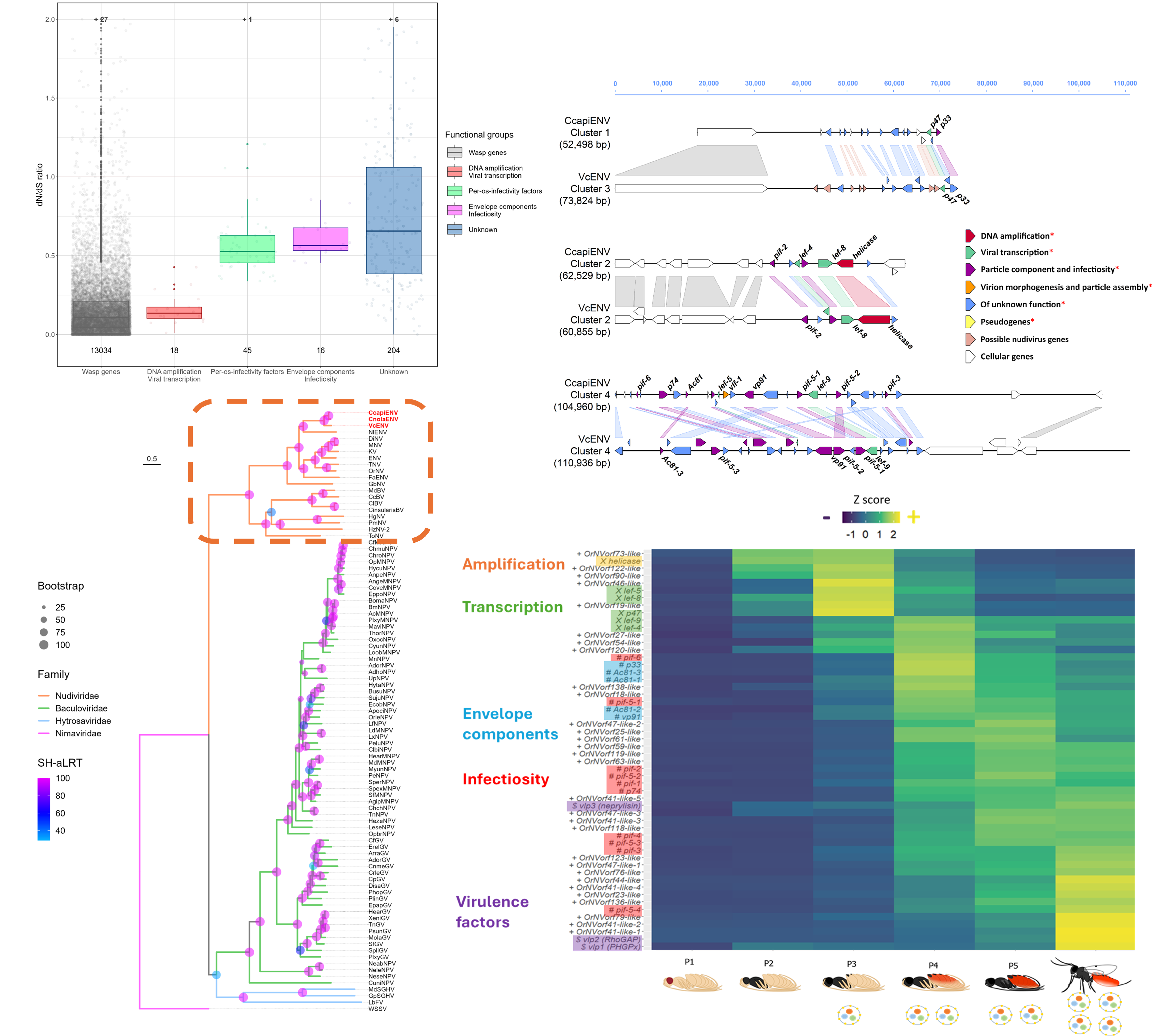
Evolution of viral symbiosis in parasitoid wasps
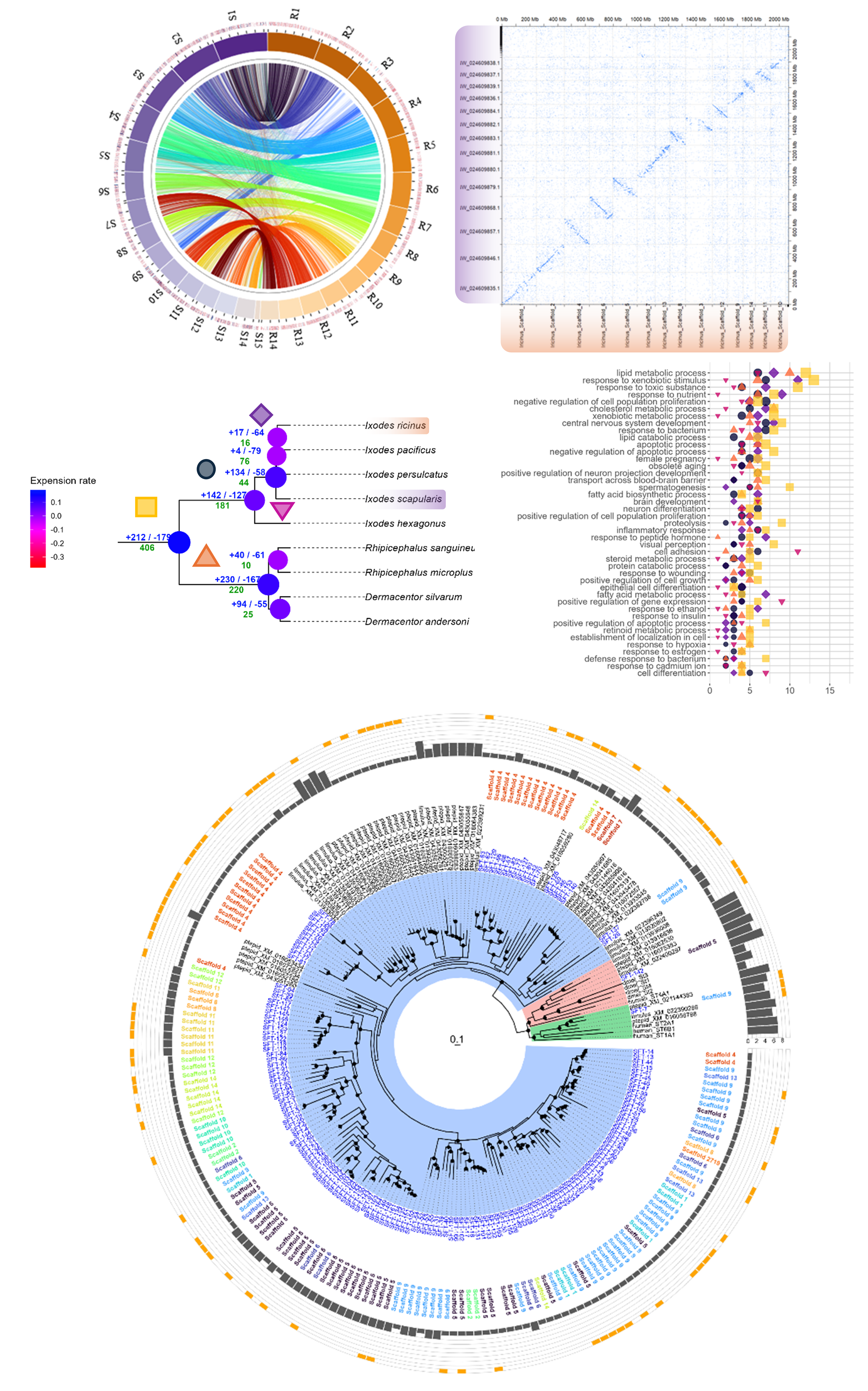
Comparative genomics in ticks
Background
I am a French researcher specialising in evolutionary biology and bioinformatics. I earned my PhD in molecular biology at the University of Tours (France), supervised by Prof Huguet and Dr Josse.
My research background focuses on evolutionary biology, leveraging genomic data to uncover insights into the evolutionary processes shaping organisms. During my PhD I explored the evolutionary dynamics of viral symbiosis in parasitoid wasps, providing insights into the interactions between wasp and viral genomes and their impact on wasp biology. Afterwards, through comparative genomics, I studied tick genome evolution, which highlighted features such as gene expansions that support their parasitic lifestyle. Beyond my primary research projects, I’ve shared my bioinformatics expertise with students and researchers, contributing to multiple publications, and taught genetics and basic evolution concepts to undergraduates.
My study approaches integrate molecular and evolutionary biology, bioinformatics, and functional and comparative genomics.
Contact: alexandra.araujo@ucl.ac.uk
Publications
Articles
- Cerqueira de Araujo A, Noël B, Bretaudeau A, Labadie K, Boudet M, Tadrent N, Istace B, Kritli S, Cruaud C, Olaso R, Deleuze J-F, Voordouw M, Hervet C, Plantard O, Zamoto-Niikura A, Chertemps T, Maïbèche M, Hilliou F, Le Goff G, Chmelar J, Mazák V, Jmel MA, Kotsyfakis M, Medina JM, Hackenberg M, Šimo L, Koutroumpa FA, Wincker P, Kopacek P, Perner J, Aury J-M, Rispe C. Genome sequences of four Ixodes species expands understanding of tick evolution. BMC Biology. 2025 Jan 21; 23(17). doi: 10.1186/s12915-025-02121-1
- Pienaar RD, Herrero S, Cerqueira de Araujo A, Krupa F, Abd-Alla AMM, Herniou EA. Optimization of screening methods leads to the discovery of new viruses in black soldier flies (Hermetia illucens). bioRxiv 2024.08.27.609913. doi: 10.1101/2024.08.27.609913
- Cerqueira de Araujo A, Leobold M, Cariou M, Ferreira dos Santos B, Uzbekov R, Ricciardi R, Scaramozzino P, Lucchi A, Musset K, Drezen J-M, Josse T, Huguet E. Discovery of new endogenous viral elements in campoplegine wasps (Ichneumonidae, Campopleginae, Campoplex) suggests a widespread nudivirus domestication event. bioRxiv 2023.12.12.569846. doi: 10.1101/2023.12.12.569846
- Cerqueira de Araujo A, Josse T, Sibut V, Urabe M, Asadullah A, Barbe V, Nakai M, Huguet E, Periquet G, Drezen J-M. Chelonus inanitus bracovirus encodes lineage specific proteins and truncated immune IκB-like factors. Journal of General Virology. 2022 Oct; 103(10). doi: 10.1099/jgv.0.001791
- Cerqueira de Araujo A, Leobold M, Bézier A, Musset K, Uzbekov R, Volkoff A-N, Drezen J-M, Huguet E, Josse T. Conserved viral transcription plays a key role in virus-like particle production of the parasitoid wasp Venturia canescens. Journal of Virology. 2022 Jun 9; e0052422. doi: 10.1128/jvi.00524-22
- Cerqueira de Araujo A, Huguet E, Herniou EA, Drezen J-M, Josse T. Transposable element repression using piRNAs, and its relevance to endogenous viral elements (EVEs) and immunity in insects. Current Opinion in Insect Science. 2022 Jan 19;100876. doi: 10.1016/j.cois.2022.100876
- Prigot‐Maurice C, Cerqueira de Araujo A, Beltran‐Bech S, Braquart‐Varnier C. Immune priming depends on age, sex and Wolbachia in the interaction between Armadillidium vulgare and Salmonella. Journal of Evolutionary Biology. 2021 Feb;34(2):256-69. doi: 10.1111/jeb.13721
- Prigot-Maurice C, Cerqueira de Araujo A, Durand S, Laverré T, Pigeault R, Verdon J, Bulet P, Beltran-Bech S, Braquart-Varnier C. Survival capacity of the common woodlouse Armadillidium vulgare is improved with a second infection of Salmonella enterica. Journal of Invertebrate Pathology. 2019 Nov 1;168:107278. doi: 10.1016/j.jip.2019.107278
Book chapter
- Hulot F and Cerqueira de Araujo A. “Effets des cyanotoxines sur les communautés zooplanctoniques en milieu lentique.” In: Bernard, C., Mougin, C. and Pery, A. (eds) Écotoxicologie, des communautés au fonctionnement des écosystèmes. ISTE, 2017, pp. 137–152.